(Commercial Transactions and ERP Transactions)
Is that good? Is that bad? Well, it depends…
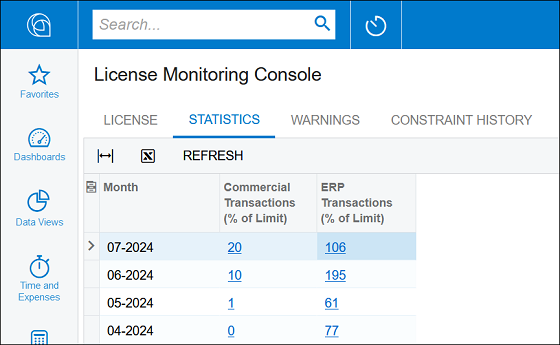
I’m creating a dedicated page for this to document my learning journey as I try to better understand Acumatica’s ERP Transactions vs. their Commercial Transactions.
You can leave a comment on the bottom of this page with your findings as you move along this journey so we can compare notes as we all go along this journey together.
This is not a comprehensive post on the topic of ERP Transactions from an expert. This is just Tim Rodman’s personal understanding and conjectures which will definitely evolve over time. I’m like a reporter in a war zone, doing my best to report on things in real-time, knowing that real-time information is sketchy, but better than no information at all.
Ok, let’s start the “understanding ERP Transactions” journey…
Acumatica is not licensed by User, but rather by Transaction Volume, specifically in 2 categories:
- Commercial Transactions
- ERP Transactions
Historically, Acumatica only cared about Commercial Transactions from a licensing perspective. As long as you didn’t go over your Commercial Transaction limit each month, then they didn’t bother you.
Lately though, I’ve been hearing that Acumatica cares more and more about ERP Transactions, even to the point of forcing customers to pay more for Acumatica if they are under on Commercial Transactions, but over on ERP Transactions.
Do you fully understand what ERP Transactions are? Take a look at the videos below for some “surprises” that you probably aren’t aware of.
The current official definition of ERP Transactions can be found buried in a paragraph on the bottom of Page 12 of the Acumatica Licensing Guide (click here):
Daily ERP Transactions: The ERP Transaction Volume (ETV) measures the number of save operations performed across all the distinct types of application entities throughout the Acumatica system. Application entities are closely related to data entry screens in Acumatica. When the system needs to save information, it must create or update a set of records related to the operation being performed. This results in at least one ERP transaction for simple operations, but there can be a few more if the save process must create or update multiple application-level entities. ERP transactions occur any time the system needs to write to the database, and not just when a user presses a “save” button. ERP transactions will also result from automated schedules that execute batch processes.
Acumatica Licensing Guide (bottom of page 12)
Do the current tiers of ERP Transactions make sense or is Acumatica starting to take advantage of their customers? It’s hard to tell at this point, but it’s up to us in the Acumatica community to keep Acumatica honest and help ensure that Acumatica continues to have a bright future.
Why do ERP Transactions suddenly matter? From what I’m hearing, they started to matter earlier this year, in Spring 2024.
Hmmm, what changed in Spring 2024? Ah yes, Zach Nelson, who was CEO of NetSuite for 15 year, suddenly joined the Board of Directors for Acumatica (click here). Is it a coincidence that Acumatica started to crack down on ERP Transactions around that time? I’ll let you decide.
Checkout the videos below for what might become an ongoing series about ERP Transactions in Acumatica.
And please leave a comment on the bottom of this page with your own experiences. Do you have a situation where your ERP Transactions counter spins out of control? Is Acumatica forcing you onto a higher SKU (M2, M3, L1, L2, etc.) if you’re over on ERP Transactions, even if you’re under on Commercial Transactions? Any other thoughts you’d like to share?
I’d love to see your comments below.
In addition to the comments below, click here for a Discussion Topic that I created on the Acumatica Community Forums.
We’re regularly getting reminded that we are running something like 400% over our ERP transaction limit. And it’s coming from three main areas:
I don’t have an issue with Acumatica tracking this–ultimately it’s what eats up the resources and if we’re hogging resources then we should probably be made aware. But all three of these seem to be more related to underlying code issues than to our usage.
Pretty quickly after creating this page, someone from Acumatica that I didn’t know reached out to me directly. I responded briefly that I wasn’t interested in anything but a public discussion. Then someone from Acumatica that I know personally reached out to me so I scheduled a call. Then we scheduled another call which included someone with a lot of technical depth.
I’ve learned two things so far:
1. This is a WAY more complicated topic than I realized. There are more moving pieces that I didn’t even know existed.
2. This has been in the works for a long time, well before Zach Nelson joined the board.
Props to Acumatica for reaching out to an Independent Consultant like me who they can’t control. Rest assured, I’m not being bribed to say nice things about Acumatica. This is a labor of love, I don’t get paid anything from Acumatica, and I will continue to report on things as I see them.
But I recognize that I need to understand things better before I publish any further content on this topic of ERP Transactions.
Since this is not my main priority at the moment, it will take some time for me to understand what is a more complicated topic than I realized so please be patient with me as I do that.
I’m writing this on August 02, 2024, right after an hour long Teams call with 2 people from Acumatica. Because of my other priorities, my next call with them won’t be until September 06, 2024. That’s a limitation on my side, not on their side, as they are committed to “scaling the knowledge” on this topic as quickly as possible.
But it’s a complicated topic (at least to me) and it’s probably going to take me a while to “get it” so your patience is appreciated.