I discovered the Entrepreneurial Operating System (EOS) from an Acumatica Customer. Since then, I’ve discovered several Acumatica Customers and Partners who use it.
3 Podcast episodes are dedicated to EOS:
Episode 136 with an Acumatica Customer
Episode 137 with an Acumatica Partner
Episode 138 with an Acumatica Customer
Episode 165 with an EOS Implementer
EOS is not a piece of software, but rather a framework for running a business (any business).
I’ll bet there are a million programs out there that teach you how to run a business, but I like EOS because it’s simple and practical. The guy who created it, Gino Wickman, lives in Detroit and his approach is a very Midwest approach. It’s hands on and it comes from Gino having worked with over 120 entrepreneurial organizations.
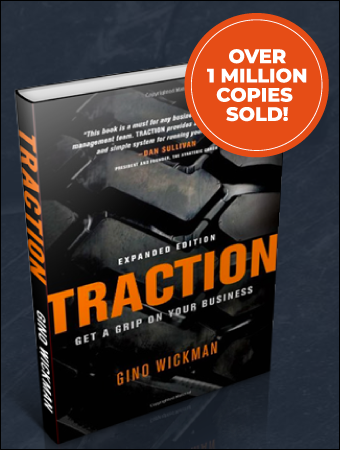
EOS is laid out in the book Traction (click here) and here are some quotes in the book from Gino about how he came up with EOS:
- “This operating system didn’t hit me like a like a lightning bolt; I’ve been refining it in the real world for over 20 years.”
- “In the last 11 years alone, I’ve completed more than 1,300 full-day sessions with the leadership teams of over 120 entrepreneurial organizations.”
- “My typical client is an entrepreneurial small to mid-size organization ($2 million to $50 million in revenue with 10 to 250 employees), growth-oriented, willing to change, and willing to be vulnerable.”
In the book, I like how Gino quotes from both gurus and his actual clients.
Regarding gurus, I asked a friend (who runs a business) recently who he gets business advice from and he named three people. One of the people he named is mentioned in Gino’s book.
Regarding actual clients, Gino weaves lots of experiences from his clients into the book. There are even key phrases that are part of EOS that were actually coined by EOS clients. Here are two different client quotes from the book:
- “These tools have been an invaluable resource for Zoup! Our company has flourished, growing from five locations to just under 50 open and awarded.”
- “I used to worry about 100 different things. Once I learned there were six components to my business and I focused on only those, those 100 different things I’d been worrying about went away. EOS made running the business simpler.”
EOS boils a business down to 3 Major Functions
- Sales & Marketing
- Operations
- Finance
EOS boils a business down to 6 Key Components
- Vision
Successful business owners no only have compelling visions for their organizations, but also know how to communicate those visions to the people around them. - People
Successful leaders surround themselves with great people. You can’t build a great company without help. - Data
The best leaders rely on a handful of metrics to help manage their businesses. The Data Component frees you from the quagmire of managing personalities, egos, subjective issues, emotions, and intangibles by teaching you which metrics to focus on. - Issues
Issues are the obstacles that must be faces to execute your vision. - Process
Your processes are your Way of doing business. Successful organization see their Way clearly and constantly refine it. Due to lack of knowledge, this secret ingredient in business is the most neglected of the Six Key Components. Most entrepreneurs don’t understand how powerful process can be, but when you apply it correctly, it works like magic. - Traction
In the end, the most successful business leaders are the ones with traction. They execute well, and the know how to bring focus, accountability, and discipline to their organization.
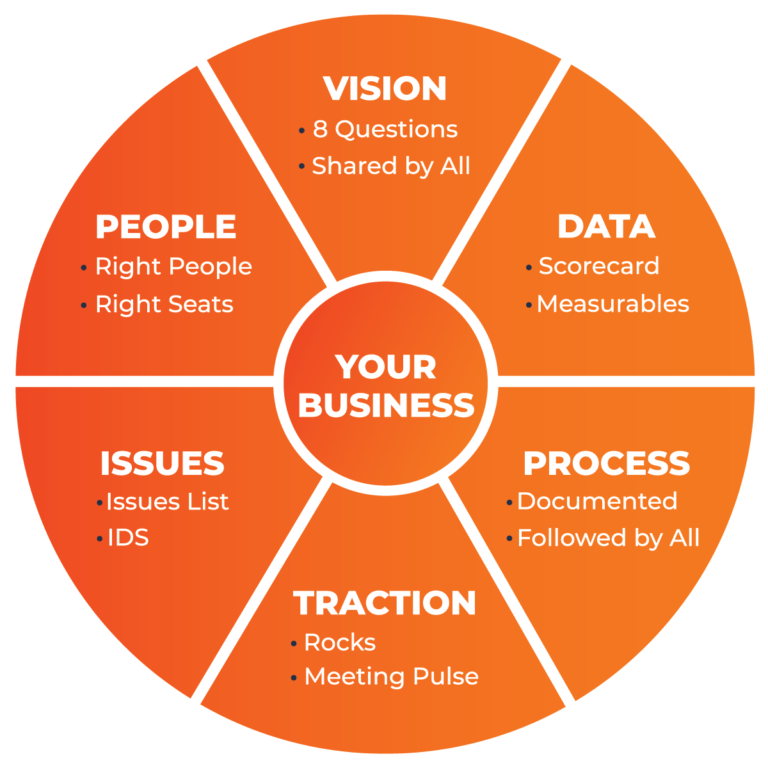
Within each of the 6 Key Components are various Tools.
There are 7 main tools (numbered below)
and 12 secondary tools (bullet points below)
- Vision: Vision/Traction Organizer (V/TO)
A two-page document capturing the company’s strategy and execution plan- Core Values
Defines the cultural DNA of the company - Core Focus
The company’s purpose + niche - 10-year Target
Long-term strategic destination - Marketing Strategy
Defines ideal customer, differentiation, and messaging - 3-year Picture
A vivid description of the company three years out - 1-year Plan
The annual goals derived from the vision
- Core Values
- People: Accountability Chart
Replaces the traditional org chart, defines roles and responsibilities, and ensures Right People / Right Seats- People Analyzer
Evaluates employees against company core values - GWC (Get It, Want It, Capacity to Do It)
Determines whether someone fits their seat
- People Analyzer
- Data: Scorecard
A weekly dashboard of 5–15 measurable numbers that predict business health - Data: Everyone Has a Number
Each employee is accountable for one measurable metric tied to the Scorecard - Traction: Rocks
The company’s 3–7 most important priorities for the next 90 days - Traction: Meeting Pulse
A structured meeting rhythm across the company (Weekly leadership meetings, Quarterly planning sessions, Annual planning sessions)- IDS (Identify, Discuss, Solve)
The EOS method for solving issues - Level 10 Meeting
The structured weekly leadership meeting - Quarterlies
90-day planning sessions - Annuals
Annual planning meeting
- IDS (Identify, Discuss, Solve)
- Process: Three-Step Process Documenter
Method for identifying and documenting the core processes of the business
Each “tool” is relatively simple, but it might take months to complete because you have to distill everything in your organization into a condensed format.
Note: You might be wondering, like I am, why the Issues component has no tools associated with it, and yet there is something called the Issues List in the graphic above. For some strange reason, the Issues List is actually part of the Vision/Traction Organizer (V/TO) which makes absolutely no sense to me, but I guess nothing is perfect 😀
Overall, though, I do very much appreciate the structure and simplicity of EOS.
The Process and Data components are especially applicable to implementing Acumatica in an organization.